Why Ukraine Continues to Fight and Why We Should Care
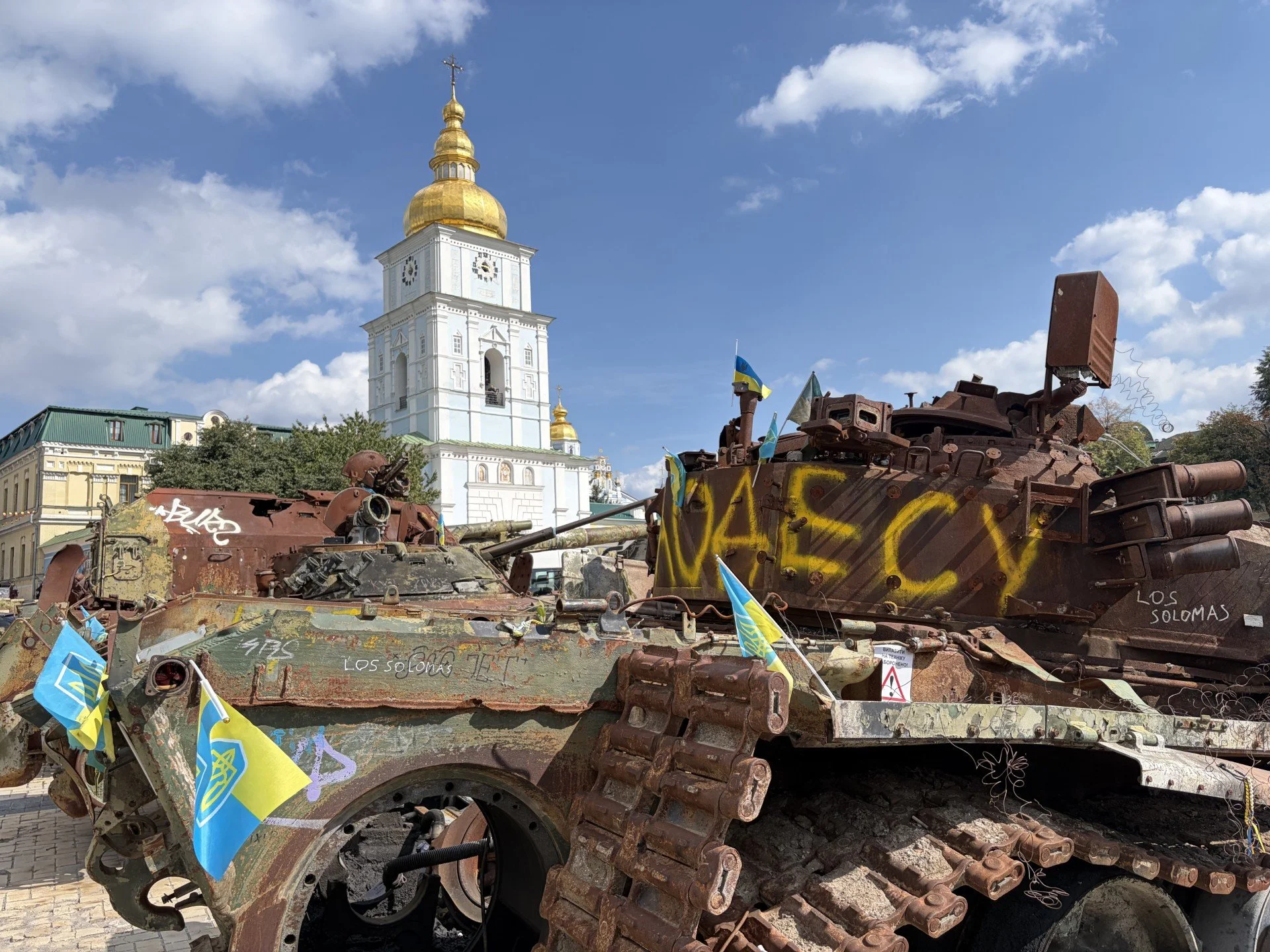
Image: Disabled Russian Tanks located at St. Michael’s Square / Amb. Kristina Kvien
Published September 28, 2026
By Ambassador (ret.) Kristina A. Kvien
The Yalta European Strategy (YES) Annual Meeting (September 11-12, 2026) was my first opportunity to return to Kyiv since my departure as U.S. Chief of Mission to Ukraine in June 2022. Despite challenging conditions on the ground, with Russia stepping up its attacks on the capital’s civilian population and infrastructure, an impressive group of current and former senior European and American officials gathered with Ukrainian officials and military commanders to discuss the current state of Russia’s war and how the West can advance peace.
Being back in Kyiv for the first time since the early days of the war, a few things struck me. As I was leaving my hotel, I heard the first of many air alerts. A glance outside showed people going about their business, largely ignoring the alarm. Deciding to do the same, I headed down the hill to St. Michael’s Square and its golden-domed monastery. There were several disabled Russian tanks on display, captured in battle and now festooned with Ukrainian flags. Further down the street, I could see the Wall of Remembrance, started after Russia invaded Ukraine in 2014 to memorialize those killed in battle. Despite these reminders of war, central Kyiv was as beautiful as ever. For those who haven’t visited, it is in many ways a typical Central European city, similar to Prague, Krakow, or Vienna. Cafes and restaurants were full, and people were out enjoying the unseasonably warm weather. As I listened to the blaring siren on my “air alert” app, it was hard to process that drones and missiles could arrive at any moment in this historic city in the middle of Europe, and difficult to understand why some in the West accept it as normal.
While the conversations at YES were too rich and detailed to summarize in full (though they are available to watch here: https://yes-ukraine.org/en/), I wanted to share a few of my key takeaways.
Ukrainians Will Not Give Up
If Putin thinks he can bomb Ukraine into submission, he is mistaken. Ukrainians well know that under Putin they will face the same horrors those in the occupied territories suffer now: “filtration,” torture, forced Russian citizenship and service in the Russian army. Ukrainians are tired. They don’t want to be lauded as “resilient” or “brave,” they are doing what they must to ensure freedom, for themselves and their children, and they pray that Western resolve will remain sufficient for them to succeed.
Bringing the Fight to Russia
Ukrainian officials and military personnel identified two things they need to get through the coming winter and keep successfully fighting: Money and interceptors. The Ukrainians have developed domestically produced drones and missiles that can reach deep into Russia and are firing hundreds per day to degrade Russian capabilities. But not only is Russia an immense, heavily militarized country, it is receiving significant support from North Korea, China and Iran. Manufacturing Ukrainian arms is expensive, and one critical capability they have not yet developed are interceptors that can stop Russian ballistic missiles. Whether through licensing arrangements or greater Western production, without more interceptors and the funds to produce domestic drones and missiles, Ukraine will face a deadly winter.
For the West to Win, Putin Must Lose
Western officials in Kyiv, including a bipartisan group from the U.S. Congress, largely agreed that Putin’s objectives go beyond Ukraine, and success in Ukraine would empower him to go further. Putin continues to play on the West’s fears of “escalation”; unity, clarity and resolve among allies are needed to show Putin he cannot succeed. Polish Foreign Minister Radosław Sikorski stated directly that “the United States has stopped funding Ukraine, what would be really helpful is for the U.S. to match the European effort.” Most agreed a “win-win” solution is not possible under current conditions; when Russia’s bottom line is Ukraine handing over territory, there is no space for negotiation. Former British Prime Minister Boris Johnson said it most clearly: “[Putin] is a creep, he’s a thug, he’s a KGB man and he’s a bully. This is fundamentally an imperial war. It’s about Russia’s sense that there’s no possibility of a Russian future, or a Russian empire, or Russian dignity without Ukraine.”
Why We Should Care
The larger question of why the United States and Europe should care about the fate of Ukraine was answered on multiple levels. First, Ukraine is a democracy seeking to fully align with the West, while Russia has become a full-fledged expansionist autocracy. It is a foundational Western principle that democracy benefits global stability. Second, appeasement doesn’t work. If Putin is allowed to succeed in Ukraine he will continue his aggression, with NATO allies among his potential targets. Third, Russia’s war against Ukraine and the U.S./Israel war with Iran have shown that the nature and technology of combat have changed. Ukraine is now at the forefront of modern warfare, with some of the world’s most battle-tested technology, tactics and troops. In recent joint exercises, Ukrainian drone units consistently outperformed their American counterparts. It is profoundly in NATO’s interest to embrace Ukraine and its expertise to ensure we are prepared for the future of warfare. Finally, China, North Korea and Iran are supplying Russia’s war machine. Their cooperation demonstrates that the conflict is no longer confined to Russia and Ukraine but is testing whether authoritarian states can cooperate to challenge a divided West. Only Ukraine’s success and Russia’s failure will send an important signal that despite our differences, the Western alliance remains strong and capable of combating the rise of autocracies intent on undermining democracies, open societies and self-determination.
Ambassador (ret.) Kristina A. Kvien assumed the role of President and CEO of Pacific Council in March, 2026.
Previously, she spent over three decades as a Foreign Service Officer with the U.S. Department of State. She retired as a career member of the Senior Foreign Service with the rank of Minister Counselor. From 2023-2026, she served as the tenth U.S. Ambassador to the Republic of Armenia. From 2019-2022, she served as the Charge d’Affaires at the U.S. Embassy Ukraine, leading the evacuation of the Embassy shortly before Russia’s further invasion in 2022 and return to the Embassy in May 2022. For her work in Ukraine, Ambassador Kvien received the Ryan C. Crocker Award for Outstanding Leadership in Expeditionary Diplomacy.
Ambassador Kvien has dedicated her career to deepening U.S. relations with Europe and Southeast Asia. She served as Acting Deputy Chief of Mission and Minister Counselor for Economic Affairs at U.S. Embassy Paris; Acting Deputy Chief of Mission and Economic Counselor at U.S. Embassy Bangkok; Economic Counselor at U.S. Embassy London; and Director for European Union, Ukraine, and Belarus Affairs at the National Security Council in the Executive Office of the President. Ambassador Kvien earlier served at U.S. Embassy Moscow; the U.S. Mission to the European Union in Brussels; U.S. Embassy Manila; and Washington DC, where she worked on European Union issues and bilateral relations with Slovenia.
Ambassador Kvien was born and raised in California, with a BA in Political Science from Occidental College and an MS in Strategic Studies from the U.S. Army War College. Prior to joining the Foreign Service, she worked in the Sales Presentation Department at the Los Angeles Times.
The views and opinions expressed here are those of the author(s) and do not necessarily reflect the official policy or position of the Pacific Council.
