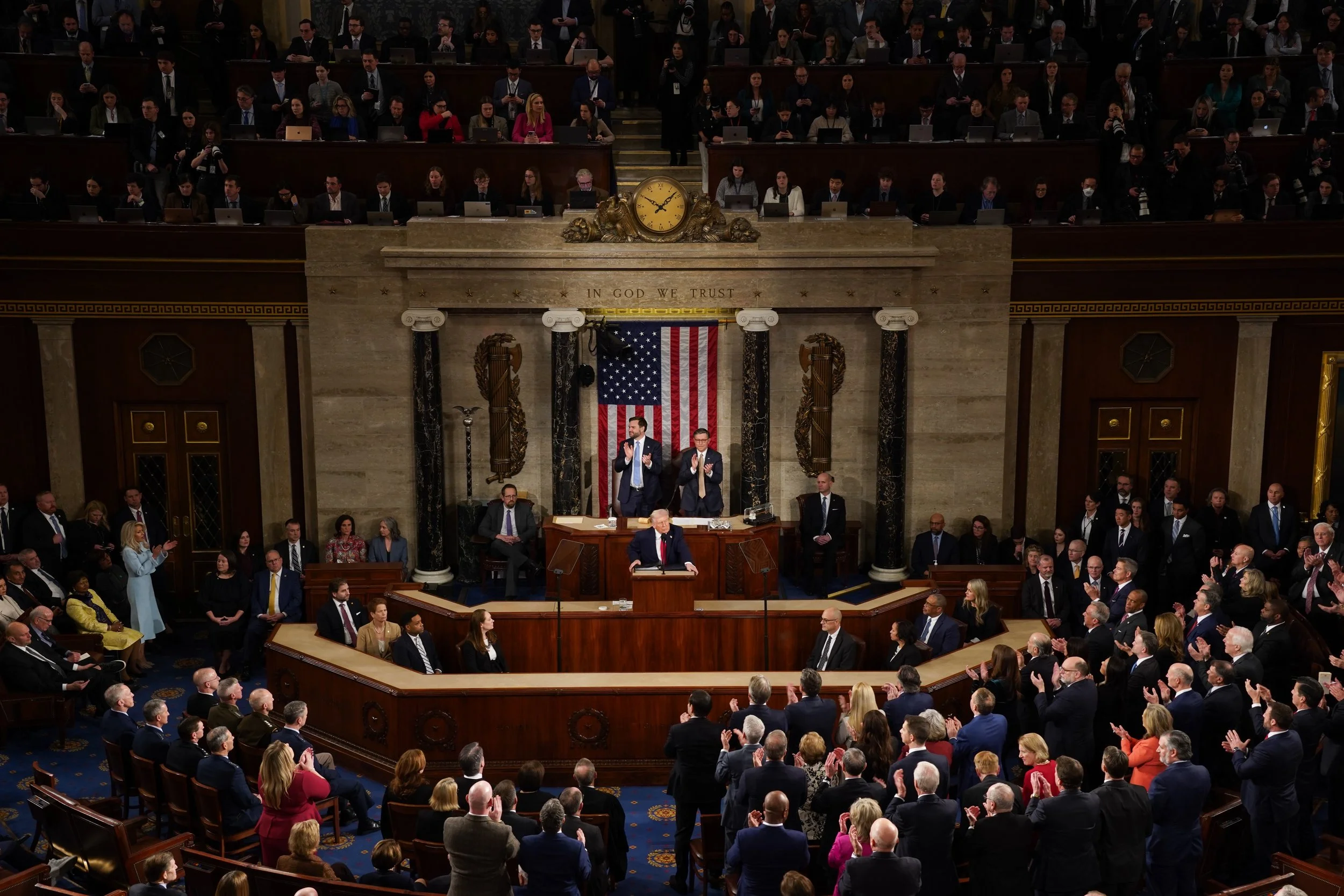
Image: Washington, D.C., USA - February 24th, 2026: President Trump speaking at the State of the Union
Published November 9, 2026
By Matthew Tuchow
As Americans confront the mounting costs of the war in Iran and growing economic pressures at home, it is time to consider what American foreign policy should look like after President Trump leaves office.
To maintain American global leadership, the next president of the United States must prioritize four changes in American foreign policy and demonstrate how each will improve the lives of Americans at home.
First, military force should be a last resort, not a first instinct.
For a generation, Americans have paid enormous costs—in lives, resources, and strategic focus—for military interventions whose benefits often proved far more limited than their advocates promised. Military power remains essential to deter aggression and defend vital American interests. But diplomacy, economic statecraft, and alliance-building are often more sustainable and less costly tools for advancing those interests. Before committing American lives and resources to armed conflict, policymakers should exhaust diplomatic alternatives and be prepared to explain clearly how military action will make Americans safer and more secure.
Second, America must rebuild its alliances and partnerships.
Many Americans understandably ask what alliances do for them. The answer is straightforward: alliances reduce the costs and risks that Americans would otherwise bear alone.
Our allies share intelligence that helps prevent terrorist attacks. They host military bases that extend American reach. They support sanctions against aggressors. They purchase American goods and services. In times of conflict, they often contribute troops, resources, and diplomatic support.
Strong alliances also help address threats that no country can solve by itself. Pandemics, cyberattacks, nuclear proliferation, terrorism, and climate-related disasters do not respect national borders. The lesson of the Covid pandemic was unmistakable: viruses do not stop at customs checkpoints. We cannot wall ourselves off from the world. America is safer when it works with trusted partners to confront shared challenges.
Alliances are also one of America's greatest advantages in its long-term competition with China. Beijing can pressure individual countries. It is far less capable of pressuring a coalition of advanced democracies acting together. America's network of allies remains one of the few strategic assets that no rival can easily replicate.
Third, America must restore the tools of influence that don’t require military force.
For decades, foreign assistance has been one of the most cost-effective instruments of American foreign policy. Although it accounts for only a small portion of federal spending, it has often delivered significant returns.
American assistance programs have helped create export markets for U.S. companies, combat disease outbreaks before they reach our shores, strengthen democratic institutions, and provide developing nations with alternatives to dependence on authoritarian powers.
President Dwight Eisenhower understood that development assistance was not simply generosity. It was a practical investment in American security and influence.
The United States should also rebuild its diplomatic capacity. Effective diplomacy is often far less expensive than military intervention and can produce more durable results. Diplomacy allows nations to manage competition, prevent conflict, and cooperate where interests overlap.
The United States should never hesitate to defend its interests and values. But we should also recognize that cooperation is possible even with countries whose governments we oppose. During the Cold War, the United States negotiated arms-control agreements with the Soviet Union. Today, the United States may find opportunities to work with rivals on issues such as public health, nuclear security, anti-piracy efforts, or climate resilience while continuing to contest areas where our interests diverge.
In the coming years, the United States should modernize and strengthen its foreign assistance and diplomatic institutions to support economic growth, improve public health, strengthen democratic governance, and offer countries a credible alternative to China's growing economic reach.
Finally, America must strengthen the domestic foundations of its power.
The United States should reduce its dependence on foreign suppliers for goods that are critical to national security, including advanced semiconductors, pharmaceuticals, medical equipment, and critical minerals. During the Covid pandemic, Americans experienced shortages of masks, respirators, and other essential medical supplies, exposing the dangers of relying heavily on overseas production for critical goods. Those shortages exposed vulnerabilities that a great power should not accept.
At the same time, America must invest aggressively in the industries that will define the twenty-first century: artificial intelligence, biotechnology, advanced manufacturing, innovative and cost-effective defense technologies, quantum computing and clean energy.
Such investments are not merely economic policy. They are foreign policy.
America's influence abroad has always rested on its success at home. The world's most talented people have long sought to study in American universities, build companies in American cities, and invest in American innovation because the United States offered unmatched opportunities for advancement and discovery.
Americans do not expect foreign policy to solve every problem they face. But they have a right to expect that it serves their interests. A foreign policy that works for Americans is not a retreat from global engagement. Responsible engagement is the only sustainable foundation for American leadership in the world.
Matthew Tuchow
Matthew Tuchow is a former General Counsel to the U.S. Department of State’s Inspector General. He has also worked on international affairs in Congress and the private sector. He is a longtime Pacific Council member and a member of Foreign Policy for America’s Leadership Circle. The opinions in this piece are his own and not necessarily those of the government or other prior employers.
The views and opinions expressed here are those of the author(s) and do not necessarily reflect the official policy or position of the Pacific Council.
