Plucky Palau is the David of the Pacific Islands Forum But Which Goliath Will It Take On?
Photo by Hector John Periquin on Unsplash
By Joseph Leonard
It was an otherwise unremarkable line, merely reiterating a decades-long agreement concerning Taiwan in the Pacific's most consequential diplomatic forum. Paragraph 66 of the 2024 Pacific Islands Forum (PIF) final communiqué initially read, “Leaders reaffirmed the 1992 Leaders decision on relations with Taiwan/Republic of China”. Yet the same night of its publication the whole communiqué – summarizing key outcomes on security, economic development, and governance from the weeklong gathering of 18 Pacific Island leaders and 21 external 'dialogue' partners – had vanished. The next morning, it reappeared on the PIF website, but this time lacking any mention of Taiwan – the result of strong Chinese objections to a perceived recognition of Taiwan as an independent entity and a broader mission to isolate it diplomatically.
At the following year’s forum, hosted by the recently China-aligned Solomon Islands, Beijing’s strategy had gone a step further. The Solomon Islands attempted to ban Taiwan altogether at China’s behest, even rejecting Taiwanese diplomats’ visas. The resulting dispute led to a banning of all dialogue partners for the remainder of that session – a compromise that satisfied no one.
On 30 January 2026, Palau’s President Surangel Whipps Jr. made clear that all dialogue partners, including Taiwan, would be welcomed back to the same annual forum his nation will host in August. “That’s what partnership is all about in the Pacific,” he said, highlighting Taiwan’s inclusion.
This was no courtesy – it was a calculated gamble. Despite facing immense external pressures – chaotic U.S. leadership, climate change, and the tug-of-war of U.S.-China great power competition – Palau just bet on the U.S.-Taiwan partnership. What makes the gamble remarkable is the pressure Palau is under – and what it signals about the new Pacific order taking shape.
What’s at stake: Why the Pacific Islands Matter Amid Security Competition
Pacific Island Countries (PICs) are becoming increasingly strategically important within the intensifying competition between the U.S. and China – especially as each prepares for a potential conflict over Taiwan. The Compact of Free Association (COFA) states of Palau, Federated States of Micronesia, and the Marshall Islands are particularly important to U.S. and Taiwanese security. As long as it provides its governments with aid, federal services, and defense guarantees, America has exclusive defense access to a maritime area bigger than the continental U.S., forming an uninterrupted corridor from Hawaii to the Philippines. This balances China’s regional power and prevents a potential flanking of U.S. forces in the Western Pacific – something that would negate an effective response to an attack on Taiwan. The costly island-hopping campaign America was forced to undertake in WWII’s Pacific theater highlights both the costs of losing influence in the region and the immensely valuable security bargain the Compacts provide.
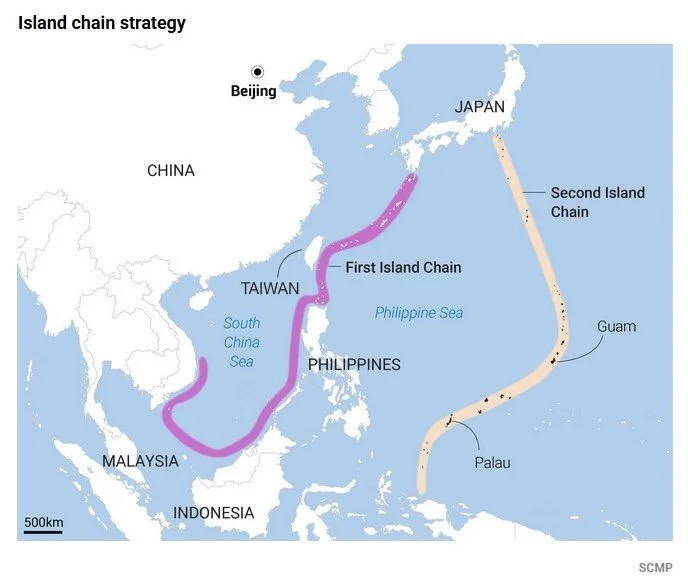
Image: Map of the First and Second Island Chains, Gwydion M Williams on Flickr, CC BY 4.0
China, meanwhile, has shown its intent to expand its regional influence and translate gains into security advantages, most notably by breaking America’s island chains. In the same vein, it has tried to delegitimize and isolate Taiwan wherever possible, especially among PICs, which represent nearly half of Taiwan’s remaining diplomatic allies and have equal voting rights in international organizations such as the United Nations.Beijing has recently secured a number of regional diplomatic victories, such as persuading the Solomon Islands and Kiribati in 2019 and Nauru in 2024, to sever their ties with Taiwan. The practical and symbolic relationships China has nurtured with regional players have developed into bilateral security frameworks, providing police training across four Pacific countries and military assistance to three others. One of the starkest examples of China’s increasing security ties to PICs is the 2022 China-Solomon Islands security pact, which includes a provision for the Solomon Islands to call in Chinese police and military forces to “maintain social order”.
How has China secured enough trust to develop security frameworks with regional players who were previously uneasy with its seemingly self-interested and coercive engagement strategy?After all, alignment with China rarely comes without a cost: PICs such as Tonga have become reliant on Chinese credit, reflecting Beijing’s global ‘debt-trap diplomacy’ strategy, which uses unsustainable debt to gain leverage over other countries. Similarly, Chinese state-owned engineering companies monopolize island construction sectors during massive development projects.The fact that PICs are willing to sideline their concerns and choose to partner with Beijing over the U.S. and its allies highlights China’s growing competitiveness.
One explanation is that aligning with China avoids the red tape of Western competitors in aid and development. It’s no coincidence, for instance, that all Pacific Islands that have opted to accept the ‘One China Principle’ and recognize Beijing over Taipei have also gone on to join the Belt and Road Initiative (BRI). This shift in perspectives now threatens the alignment of the Freely Associated States, with Micronesia reportedly growing closer to China and showing an interest in the BRI. Amidst Chinese gains across a contentious region, the island nation of Palau, with its population of merely 18,000, stands as an outlier, resisting some of the most intense pressure in the area.
Navigating Choppy Waters: The Pressure Palau Faces
A COFA state and key middle player in the U.S.-China regional rivalry, Palau sits at an inflection point. The outspokenness of Palauan President Surangel Whipps Jr. in his rejection of Beijing and support for Washington leaves little room for questions of loyalty. Whipps has said that his country is “already at war with China”, accused China of attempting to “erode leadership, disrupt vital services, and weaken confidence in government,” and even of trying to weaken the Palauan community by sending drugs to wash ashore. In response, President Whipps has called for increased U.S. military presence in Palau and the region.
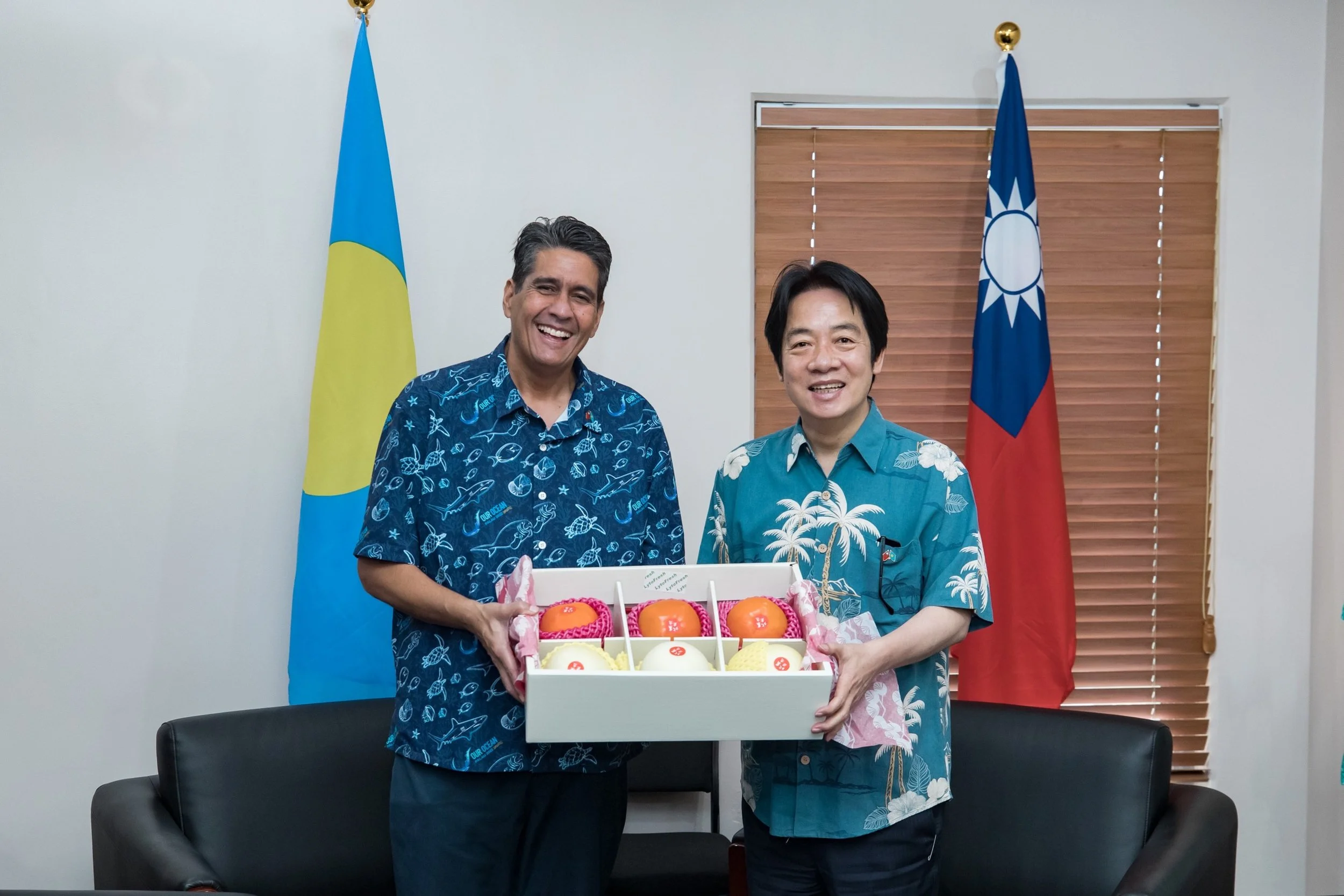
Palau has also cultivated deep ties with Taiwan. The latter has provided extensive assistance to the former: sending agricultural experts to work alongside locals, assigning medical teams to small island clinics, funding local entrepreneurs, and inviting students to Taiwan on scholarships. This has earned Taiwan considerable goodwill among many Palauan officials who call it a “reliable partner” and a “trusted friend”. Taiwan's ambassador to Palau, Jessica Lee, has said that local leaders assured her that the relationship was "solid as a rock until death do us part".
This closeness with Taiwan has drawn the ire of Beijing and sparked a coercive campaign against Palau. A key weapon in its arsenal has been the targeting of Palau’s tourist industry – the country’s largest economic driver in 2025. Beijing built up a Palauan dependence on Chinese tourists, then pulled the plug in 2017 after Palau refused to derecognize Taiwan. This happened again in 2020 when China reportedly offered a million tourists as an incentive, which was rejected by President Whipps, who noted, “Sometimes we have to look beyond money. We have to look at what is good for the safety and security of our people long term.” In response, China’s Ministry of Foreign Affairs issued a travel alert in 2024 urging its citizens to “exercise caution” in Palau, reportedly causing visitor numbers from China to halve in that year.
Besides playing push-pull with its tourists, Beijing has also been accused of using business investments in Palau as a cover for surveillance and espionage. Chinese companies and citizens have secured 99-year leases (foreigners can only lease Palauan land for up to 99 years, not buy it) on highly strategic land, such as next to U.S. military facilities and airports. According to President Whipps, land has also been bought only to be left empty where economically enriching development could have occurred. Jennifer Anson, Palau’s National Security Coordinator, said “these investments or leases are not legitimate businesses,” adding, “when the time comes that China invades Taiwan, these could be transformed into military sites.”
Chinese influence operations have targeted Palau’s media environment and interfered with its elections, which failed to stop Whipps’ 2024 presidential victory. China has also engaged in hybrid warfare tactics such as cyber-attacks and naval intrusions.
Yet China is far from Palau’s only worry: the country faces an existential threat from climate change. Rising sea levels threaten taro farming – a crop crucial to Palauan food security – while warming waters bleach coral reefs that form the bedrock of its tourism industry. Accordingly, Palau has adopted a strategy of climate leadership. This, however, risks clashing with President Trump’s outspoken climate change denial. President Whipps held the first-ever press conference underwater and has even invited Trump to take part in a snorkeling trip that would reveal the damage of climate change. But a president who has twice withdrawn the U.S. from the Paris Climate Accords is unlikely to take the plunge anytime soon. And so, a compounding dilemma: speaking out risks alienating Washington, while staying silent jeopardizes Palau’s very survival.
Growing uncertainty about America’s commitment to Palau and other Freely Associated states has been heightened by recent aid cuts, tariffs, and perceptions of U.S. political instability. The Trump administration’s chaotic U-turn on global priorities had a dramatic effect on Palau and its neighbors. The Palauan Red Cross saw a loss of more than $600,000 in humanitarian aid due to USAID cuts, while agency purges and DOGE’s dismantling of development infrastructure shocked COFAs largely reliant on federal agencies and services. U.S. Compact aid underwrites Palauan government operations, and, as one international development official said, “Without U.S. support, the system wouldn't hold.” While Palau fortunately escaped Trump’s tariffs, the other two Freely Associated states didn’t – a reminder that exemptions can be revoked. Perceptions are critical within great power competition, and America’s unpredictability may contrast starkly against China’s – albeit autocratic – stability.
Concerns over a lack of security guarantees in an area witnessing a tense U.S.-China military buildup have channeled Palauans’ World War II trauma (when U.S. and Japanese forces fought over the islands) into current security anxieties. For instance, as the U.S. builds an advanced long-range radar on Palau, which will dramatically enhance American combat readiness, residents with familial memories of being caught in the devastating crossfire of war are understandably worried. Such sentiments explain a petition calling for discussions with the U.S. on creating an agreement detailing how the U.S. would protect Palau and its citizens in the event of conflict.
Squeezed between perilous options, Palau has no easy or obvious solution to chart a more secure course. However, its attitude towards the upcoming PIF will provide a valuable window into its priorities.
The Forum: A Test of Palau’s Choice
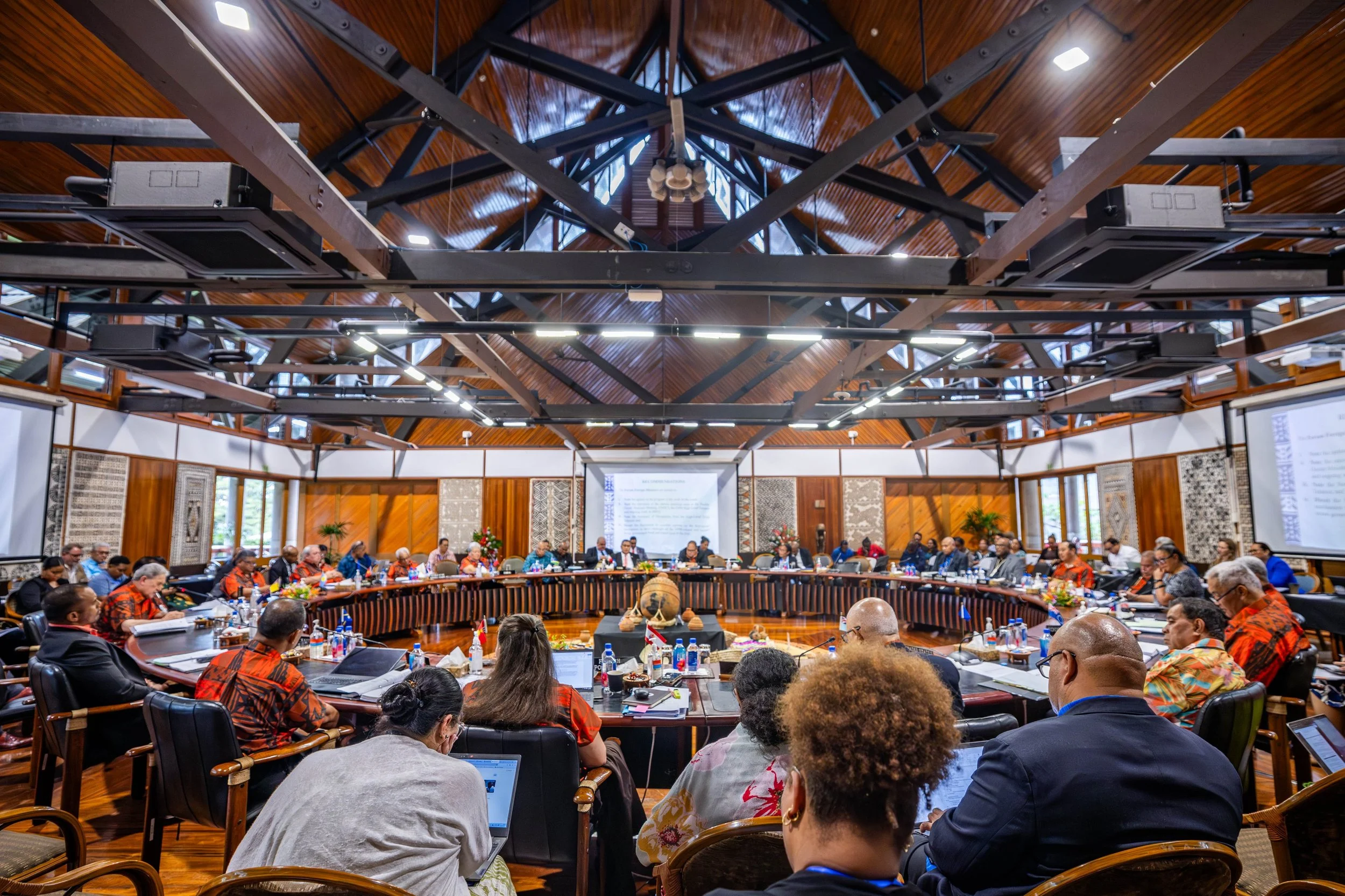
Image: Pacific Islands Forum Foreign Ministers meet in Suva, Fiji, August 2025, Pacific Islands Forum Secretariat / @ForumSEC
As host of the 2026 Pacific Islands Forum, Palau controls the agenda and invitation list for dialogue partners. While the forums of the last two years saw intensifying Chinese pressure to exclude Taiwan, President Whipps' announcement in January this year reversed this trajectory. Despite the pressures of navigating an escalating great-power rivalry, climate concerns, and the uncertainty of U.S. commitment, Palau appears to be standing firm on its longstanding U.S. and Taiwanese alignment. Three factors help to explain why:
1. A Strong Taiwan Partnership
Palau sees its relationship with Taiwan as too valuable to abandon, a bilateral priority most recently evident in Taiwanese Foreign Minister Lin Chia-lung’s visit to Palau in December 2025. Lin emphasized Taiwan’s goal of helping Palau to successfully host the forum, while also taking the opportunity to see the planned venue and pledge assistance with green transport options for delegates. This further exemplifies Palau’s intention to promote Taiwanese engagement and strengthen ties ahead of August. No less important is the loss of credibility President Whipps would face by backtracking on Taiwan. Capitulating to China when his political brand is heavily tied to standing up to it would be political suicide.
2. The Migrant Deal: Locking in American Support
Recent movement towards finalizing a migrant deal between the U.S. and Palau reflects Palau’s inclination toward strategic partnership. Despite considerable controversy, President Whipps signed a memorandum of understanding with the U.S. in late December 2025 to take up to 75 “third country nationals” who cannot be deported to their countries from America. In return, Palau would receive $7.5 million in aid, including security and law enforcement assistance which specifies an agreement to counter Chinese political warfare attacks on Palau. The deal, which was rejected twice by both U.S. congressional leaders and Palauan chiefs, and blocked again most recently in January 2026 by Palauan lawmakers, has received mixed reactions from its citizens over concerns about the country becoming a U.S. dumping ground. While the final decision is likely to come down to a public referendum, President Whipps’ pursuit of a deal despite domestic opposition indicates a willingness to make controversial deals with the U.S. While exposing the transactional nature of Trump-age relations, it also demonstrates that elements of Palauan leadership are willing to endure political costs to ensure the continuation of U.S. support.
3. U.S. Strategic Continuity Despite Political Uncertainty
The Trump administration’s newest National Security Strategy (NSS) signified a doubling down on America’s pivot to the Pacific – and therefore Palau. The document notes the importance of deterring Chinese aggression by “building alliances and strengthening partnerships in the Indo-Pacific that will be the bedrock of security and prosperity long into the future.” Cleo Paskal, a non-resident Senior Fellow at the Foundation for Defense of Democracies, believes Palau and the region at large should be considered “Western Hemispheric Adjacent” within the context of the NSS’s focus on “Hemispheric Defense” and therefore core to U.S. national security. The U.S. strategic community’s continuing recognition of Palau’s importance despite the varying positions taken by the president might provide some reassurance of American commitment. Additionally, if passed, the security and anti-coercion provisions of the migrant deal could enhance Palauan resilience to Chinese pressure during the PIF. Palau’s moves to hedge with the U.S. show that America is still perceived to be the country’s most viable security guarantor.
What Happens Next: Three Scenarios for August 2026
If previous years are any indication of the future, this year’s forum will likely see a clash between a meddling China and the U.S. – and their respective allies. With Palau’s decision to include all partners now in the public domain, three scenarios could emerge either before or at the forum:
Scenario 1: China Retaliates
In the first, Beijing could lean on established coercive methods to pressure Palau into capitulation, including more economic threats such as restricting tourism from China and the use of hybrid tactics. A diplomatic offensive could see China encouraging a boycott of the forum by its regional allies. The U.S. may find itself forced to intervene, demonstrating tangible support for Palau and Taiwan in a test of its credibility. This scenario could cause a clear regional division between those aligned with Washington and Beijing, and a likely fracturing of PIF unity.
Scenario 2: China Uses Indirect Pressure
China could also demand that Beijing-aligned PIF members contribute to its strategy of isolating Taiwan. This may avoid a direct confrontation with the U.S. while still undermining the legitimacy of the forum, and by association, Taiwanese engagement. The Trump administration’s regional disengagement may limit U.S. response options to this strategy. However, working alongside allied forum participants such as Australia and New Zealand could mitigate Beijing’s success. Whether or not Chinese gains are possible, a failure to whip up a united repudiation of Beijing’s interference would likely mark the normalization of its interference at regional forums.
Scenario 3: Restraint from All Parties
China could also decide to accept Taiwanese participation without major escalation. At best this could imply limitations to Chinese coercive power. However, it could also be part of China’s plan to bide its time until another Beijing-aligned country hosts the forum. Nauru, for instance, is slated to host in 2028. At that point, China could press more effectively for drastic exclusionary measures to be taken against Taiwan.
Which scenario occurs and how it unfolds is less likely to depend on Palau following through on President Whipps’ decision to include Taiwan in the forum, and more on how Beijing and Washington respond, introducing some important wild cards. First, the consequences of President Trump’s unpredictability should never be discounted. For instance, if Palauan climate activism begins to clash more drastically with the president’s agenda of climate denial, the relationship could quickly sour.
Any change in the dynamic between the U.S. and China could also alter the approach of each to the forum. The Trump administration recently appeared hesitant to back Japanese Prime Minister Sanae Takaichi following Chinese backlash over her comments about defending Taiwan. If China ratchets up the pressure on Palau, could a similar lack of support occur? There are many ways in which the situation could change before August. Vigilance over high-level mentions of the forum and positions on controversial issues can offer clues as to how the situation might change.
A Test Case for a New Pacific?
Palau is bearing many conflicting burdens. As China continues to target it in a coercive pressure campaign, Palau must simultaneously contend with the chaotic changes in America’s global engagement – an endeavor of critical importance considering Palau’s reliance on the U.S. Cuts to aid and the willingness to tariff impoverished COFA states are surely creating a sense of unease over Palau’s vulnerability to future uncertainty. Furthermore, the Trump administration’s climate policy (or lack thereof) complicates Palau’s outspokenness on an existential issue. Lastly, U.S. military posturing in and around Palau has islanders worried over their fate in the event of conflict.
Despite all this – and the domestic backlash over an uncertain migrant deal – President Whipps has boldly decided to align with the U.S. and Taiwan. August will be the first test of whether that choice was wise or misguided. The rest of the Pacific will be watching carefully to determine the consequences of rejecting a belligerent China for an increasingly unreliable America, with the outcome almost guaranteed to shape regional alignment for years to come.
Joseph Leonard is a foreign policy researcher and writer specializing in Indo-Pacific security and U.S.-China strategic competition. Previously a Junior Fellow at the Pacific Council on International Policy, his work has appeared in the Pacific Council Magazine and Small Wars Journal. Leonard holds a BA in Politics and International Relations from the University of Kent, where two years in the British Army’s University Officer Training Corps shaped his interest in security affairs. He currently studies Mandarin at the China Institute in New York in preparation for language immersion in Taiwan this fall.
The views and opinions expressed here are those of the author(s) and do not necessarily reflect the official policy or position of the Pacific Council.
