Diego Garcia—Between Defense and Diplomacy
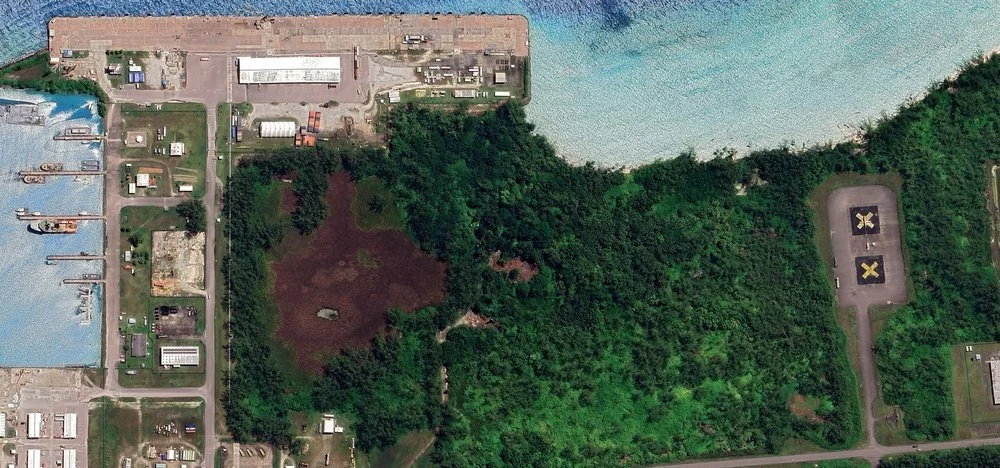
Photo: Aerial View of Pristine Coral Atolls in Chagos Archipelago, British Indian Ocean Territory - Tropical Marine Sanctuary
By Summer Lai
In May 2025, the U.K. and Mauritius governments inked a landmark treaty to transfer the sovereignty of the Chagos Islands (British Indian Ocean Territory) back to Mauritius — while the U.K. retains control of the Diego Garcia coral atoll as a U.S.-U.K. military base under a 99-year lease. While finally taking a step towards alignment with long-standing International Court of Justice (ICJ) rulings, the negotiated agreement continues to come under scrutiny — both in how it allows for and even takes a step further in legitimizing continued military presence on Diego Garcia, as well as its disacknowledgment of past harms to the local Mauritian community.
This article examines how the sovereignty transfer will redefine Diego Garcia as a concurrent instrument and symbol of global power dynamics — bearing testament to whether military strategy can coexist with principles of sovereignty and international law. By centering this piece around the human, moral, and geopolitical consequences of defense strategy, this analysis shows that military effectiveness is deeply intertwined with political negotiation and moral responsibility, regardless of whether it is acknowledged. Rather than disavowing legitimate defense needs, the article also attempts to outline the costs, compromises, and contradictions embedded within global power projection. In so doing, it argues that understanding such strategic trade-offs is essential for informed discourse on security, decolonization, and the credibility of the international rules-based order.
Introduction
At the center of this debate lies Diego Garcia — a coral atoll in the central Indian Ocean that has become one of the most strategically significant military installations globally. Diego Garcia anchors the U.S. power projection strategy across East Africa, the Middle East, and South Asia, while also serving as a critical logistics and contingency hub for broader Indo-Pacific operations. Since the 1970s, Diego Garcia has been home to a joint U.S.-U.K. military base, supporting long-range bomber operations, naval logistics, and force deployment — functions that have made the base an indispensable node within American defense strategy in the region.
Yet, Diego Garcia's strategic value cannot be separated from its colonial legacy, existing only because of how the U.K. had extricated the Chagos Archipelago from Mauritius before the establishment of Mauritian independence. The Chagossian population had also been evicted to clear the islands for military use. In effect, the 2025 sovereignty agreement between the U.K. and Mauritius will finally extend a formal acknowledgment of Mauritian sovereignty over the archipelago, while preserving Diego Garcia’s ability to host the U.S.-U.K. military base, reframing the island as a shared site of post-colonial restitution and great-power militarization.
Under the terms of the agreement, the U.K. government would pay Mauritius an average of £101m a year for 99 years. In return, the deal sets a 24-mile buffer radius around Diego Garcia, in which any form of construction requires U.K. governmental consent. Foreign military and civilian forces will also be barred from all other islands in the archipelago, with the U.K. retaining full veto power over access to the islands. The treaty, however, has yet to be ratified and will only come into effect after approval by both the U.K. and Mauritian parliaments.
Strategic Defense Core
Diego Garcia serves as a central strategic hub for U.S. military operations due to its advanced infrastructure and geostrategic positioning. The base features a long-runway airfield, deep-water naval anchorage, and extensive logistics facilities, allowing it to support air, naval, and joint operations across multiple domains. In addition, Diego Garcia’s location enables military reach across both the Indo-Pacific and the Middle East, placing it within the operational range of East Africa, the Persian Gulf, South Asia, and even parts of Southeast Asia. Diego Garcia’s ability to host and sustain these forces, independent of any regional host-nation’s approval, grants it an unmatched degree of strategic flexibility. Another deliverable of its geostrategic isolation is Diego Garcia’s relative insulation from many of the political and physical vulnerabilities that affect bases closer to contested mainland regions. This relative distance reduces the base’s exposure to domestic political pressures or immediate conventional threats, enhancing the survivability of the base on both political and operational counts.
Operational Resilience
Beyond its immediate military function, Diego Garcia serves a critical purpose within the broader U.S. defense strategic frameworks, centered on resilience and endurance. Rather than being a frontline operating theatre, Diego Garcia serves as a secure logistics and rearmament node. Diego Garcia is also one of the few global bases capable of reloading submarines with advanced munitions, and it hosts a significant supply of pre-positioned equipment and stores. Such a logistics complex enables the rapid deployment of air and marine forces, reducing dependency on vulnerable supply convoys to transit contested regions. Diego Garcia thus provides redundancy, serving as a resilient option that helps to sustain continued operational momentum even if forward bases are compromised. This endurance logic may explain the enduring significance of the base, even as it remains mired in legal, ethical, and political controversies.
Politics of Sovereignty
In 2019, the International Court of Justice issued an advisory opinion declaring the decolonization of Mauritius incomplete — a position that was subsequently reinforced by UN General Assembly resolutions calling for the return of the archipelago to Mauritius. These advisories did little to alter operational realities on Diego Garcia itself. However, they did reshape the political environment within which the base exists — increasing reputational costs for its continued operation under the premise of unresolved sovereignty. In this light, the 2025 U.K.–U.S.–Mauritius sovereignty agreement reflects an attempt to reshape the political environment through means of formal legal settlement. Under the deal, Mauritian sovereignty over the Chagos Archipelago is to be recognized, while Diego Garcia remains under U.S. and U.K. operational control through a long-term lease. Crucially, the agreement explicitly guarantees military access for 99 years and bars Mauritius’ interference in any form of basing operations. In other words, sovereignty is acknowledged in principle, but strategic control continues to be preserved in practice.
In effect, such an arrangement insulates military operations from political volatility. By embedding operational guarantees within an international treaty, the agreement decouples the base’s strategic function from shifts in domestic politics, diplomatic disputes, or renewed legal challenges that may arise in the future. In so doing, it reflects a broader resilience logic — strategic permanence achieved at the price of sovereign flexibility. Diego Garcia is no longer a legally ambiguous colonial legacy, but neither will it transition into a site of full political reintegration. Instead, it nestles in this carefully negotiated space — where post-colonial justice and military necessity coexist uneasily, carefully managed by means of law rather than unequivocal resolution. In this sense, the case of Diego Garcia demonstrates how legal and diplomatic mechanisms are employed not simply to address historical claims but to secure operational continuity and further national security interests. Sovereignty settlements can serve strategic ends as much as ethical ones — structuring political authority in ways that stabilize military access while managing, rather than eliminating, underlying tensions of history.
Rules-Based Order
The dispute over Diego Garcia presents a revealing test of the rules-based international order. Beyond the legality of a single military installation, the more pressing stakes lie in the broader credibility of claims that geopolitical and military power can be exercised within a framework of law, accountability, and regard for sovereignty. Maintaining a strategically vital base on territory long recognized as unlawfully detached raises questions about whether adherence to international norms should be contingent on principles or on strategic convenience.
From a legal perspective, the continued operation of the base has long sat in tension with international law. Advisory opinions from the ICJ and repeated UN General Assembly resolutions have affirmed that the “process of decolonization of Mauritius was not lawfully completed in 1968,” and that “the detachment of the Chagos Archipelago was contrary to the principle of territorial integrity because it was not based on the free and genuine will of the people concerned.” Although advisory opinions are not technically legally binding, the sustained disregard risks eroding the authority of international legal institutions and exposing a concerning pattern of selective compliance that ultimately weakens the universality of the rules-based order. As Dr. Garret Martin, Hurst Senior Professorial Lecturer at American University observes, "if basically any great power can declare that it can be both judge and executioner when it comes to international law, it's hard for specifically smaller countries to have trust that their interests and their rights will be respected." The implications of this dynamic extend far beyond the specific case of Diego Garcia, and ultimately pokes at who international law is fundamentally designed to serve.
The 2025 sovereignty agreement seeks to address this contradiction by formally recognizing Mauritian sovereignty, whilst retaining military basing rights through a lease arrangement. In doing so, it transforms Diego Garcia from a colonial flashpoint into a negotiated security arrangement, taking a step in aligning U.S. and U.K. strategic practice more closely with their stated commitment to international law and the wider rules-based order. Such an approach proposes that legal compliance and military necessity need not be mutually exclusive, and that long-term strategic credibility hinges on the responsible wielding of power. In directly confronting the issues of sovereignty, the Diego Garcia settlement agreement represents a crucial step towards reinforcing the consistency and credibility of the rules-based international order.
The Chagossians
However, legal resolution does not fully confront the moral dimensions in this case and continues to leave questions of historical accountability unresolved. The displacement of the Chagossian people and the limited scope of restitution within the agreement underscore the ethical trade-offs also often witnessed in strategic basing decisions. The Diego Garcia settlement highlights the human cost embedded within geopolitical strategy — of which the Chagossian people are subject to, but do not have control over. When the U.K. assumed control of the Chagos Archipelago in the 1960s, more than 1,000 residents were rapidly evicted to make way for the military base. This forced removal severed the local population from their homes and livelihoods in service of broader security objectives — illustrating how strategic imperatives can override the rights of relatively powerless communities.
Recent agreements acknowledge this injustice but fall short of sufficient restitution. Measures such as financial support through a trust fund, limited consultation, and commitments to heritage visits represent partial recognition, rather than an attempt at comprehensive redress. Questions remain about whether these provisions meet standards of effective remedy — or more fundamentally, what the provision of a remedy even means. As Dr. Martin also notes, "the fear is that we're not going back to a situation where de jure sovereignty or control might be given back, but in practice, that's not really the case" — a concern that speaks directly to whether the local Chagossian population stand a chance at meaningful restitution, or merely its symbolic appearance.
The debate surrounding the agreement also reveals the contested nature of justice in strategic compromises. While some Chagossians — particularly in Mauritius and the Seychelles — have supported the deal, others, including members of the U.K.-based community, argue that their voices were insufficiently heard. Such division underscores a recurring moral tension in geopolitics: even when states seek to correct past wrongs, the outcomes often reflect negotiated trade-offs that prioritize strategic stability over any clear conception of what restoring displaced communities represents and demands.
Together, these dynamics demonstrate that geopolitical and military decisions come with their share of humanistic costs. The case of Diego Garcia reflects how the pursuit of strategic advantage can produce enduring human consequences, and how subsequent efforts at legal or diplomatic repair may ultimately only serve to acknowledge some portions of past injustices. In so doing, it exposes the moral limits of compromise within a rules-based order shaped as much by power as by principle.
Conclusion
Diego Garcia ultimately stands as a consolidated reflection of the dilemmas at the heart of contemporary security politics. The 2025 sovereignty agreement demonstrates that even deeply embedded military arrangements can offer room for legal and diplomatic recalibration, and that strategic imperatives can, to some degree, be reconciled with international norms of sovereignty. That said, the agreement also exposes the limits of such reconciliation. The insulation of military operations from political interference underscores how sovereignty settlements are often designed with greater strategic resilience considerations, rather than meaningful political reintegration. Far from erasing asymmetries of power, legal compliance can instead be used to manage and strengthen them. International criticism and unresolved questions surrounding Chagossian rights highlight how strategic necessity continues to define the outer bounds of restitution, ultimately leaving moral accountability only partially accounted for.
Looking forward, Diego Garcia offers sobering lessons amidst an evolving global order. As geopolitical competition intensifies, the strategic importance of remote territories reshapes, and legacies of colonial governance persist, similar trade-offs are likely to reemerge. The durability of the rules-based international order will depend not only on formal legal alignment but on sustained attention to how strategic choices distribute risk, responsibility, and harm. Diego Garcia does not suggest that power politics can be transcended — but rather it proposes that their legitimacy will increasingly hinge on whether the costs imposed are acknowledged, contested, and meaningfully addressed, rather than quietly absorbed by those with the least voice. Recognizing and confronting these trade-offs — rather than papering over them — will be essential if future security arrangements are to command both the legal legitimacy and moral credibility that in turn best serve their operational interests.
Summer Lai is an undergraduate at UCLA from Singapore. She is pursuing a B.A. in International Development Studies, with minors in Geography/Environmental Studies and Education. She is interested in how institutional change drives national resilience, with a focus on the intersections of political economy, defense policy, and sustainable development. Her work examines how governance systems, strategic infrastructure, and cultural forces interact to shape how states adapt to shifting global and regional pressures.
The views and opinions expressed here are those of the author(s) and do not necessarily reflect the official policy or position of the Pacific Council.
