Inside “Latin America”: How a Nineteenth-Century Label Narrows U.S. Thinking—and Fuels Twenty-First-Century Mistakes
By Naseem Qader
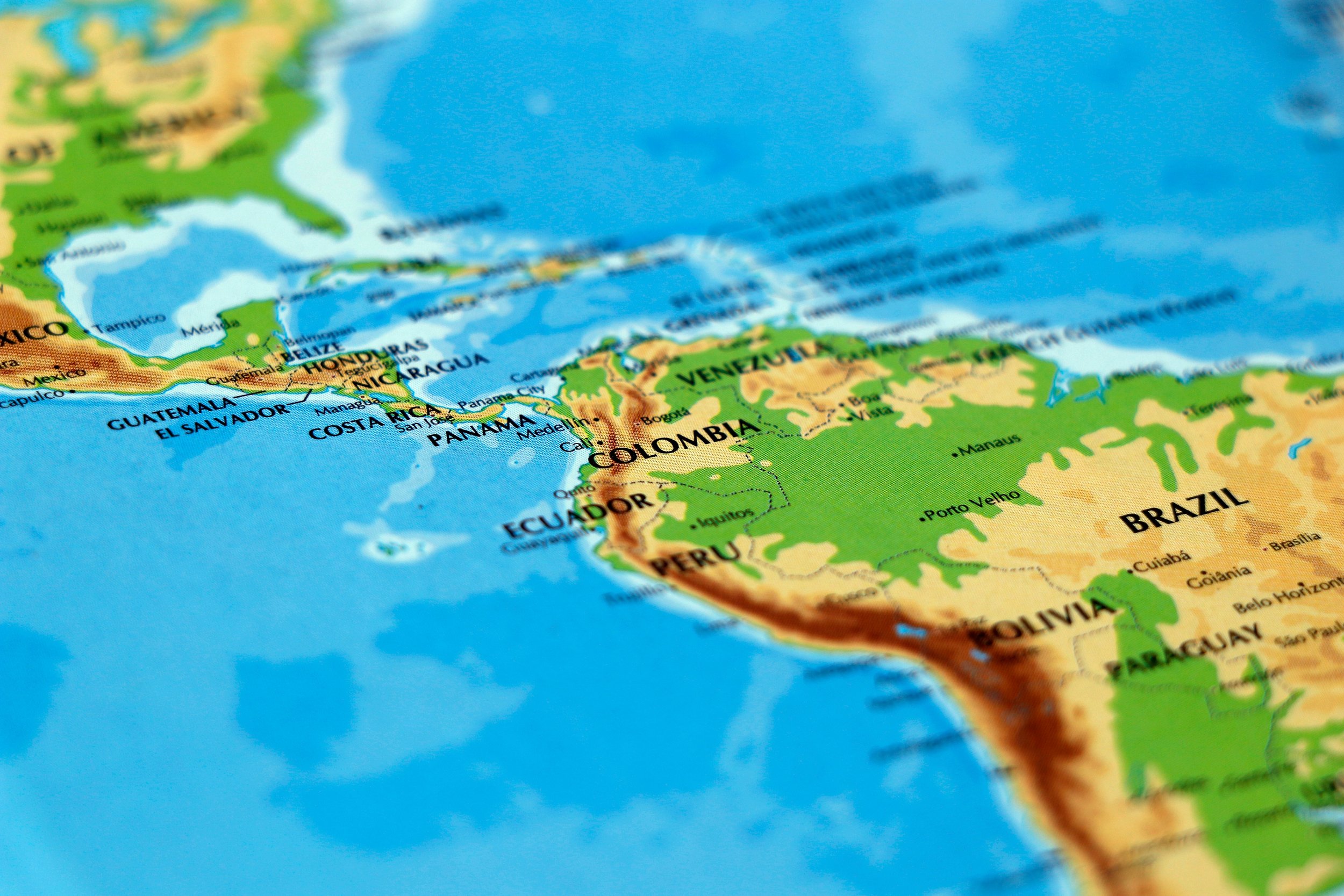
In U.S. debate, “Latin America” often enters the room as a single image: the border under strain. Raids. Seizures. People on the move. From farther north, that whole picture gets translated into “border pressure”—a phrase that scrubs out cause and turns a long chain of what people are up against into one security problem. The name hides what’s in plain sight: a vast and varied stretch of the Western Hemisphere that sets what the world eats, how climate risk compounds, and where the metals for electrification come from.
This isn’t a story of absence. Successive United States administrations have signed trade deals, backed regional institutions, and worked with governments from Mexico City to Bogotá and Brasília on security, health, and development. The trouble is what happens when a whole hemisphere gets flattened into a single storyline—and we end up governing the storyline.
That narrowing isn’t just incomplete. It’s costly. A strategy that treats “Latin America” mainly as a source of drugs and “illegal migrants” will keep chasing symptoms and keep missing where leverage and fragility actually sit.
For California and the broader Pacific community, the consequences don’t stay theoretical. Latin America sits across our ocean lanes, our ports, our power grids, and our migration debates. What happens there will shape food and energy prices, test North American supply chains, and set the foreign policy choices the United States makes from the Pacific coast outward.
A label that quietly reshapes strategy
“Latin America” is convenient. It is also an imprecise lens. It squeezes dozens of countries into one mental bucket, as if Mexico and Uruguay face the same pressures, as if Haiti and Chile share the same institutional story, as if Brazil and Guatemala can be read as comparable simply because they sit south of the Rio Grande. It also leaves the Caribbean in a blur—sometimes folded in, sometimes treated as separate—despite its importance to shipping lanes, energy logistics, and the movement of people.
The term has a history. It took shape in the nineteenth century as a political idea—useful for grouping, persuasion, and power—more than as a faithful description of a coherent region. Historians have traced how “Latin America” was mobilized in mid-nineteenth-century debates about empire, identity, and resistance long before it became routine policy shorthand, as detailed in Michel Gobat’s The Invention of Latin America.
That legacy hasn’t faded. In briefings, headlines, and campaign talk, the phrase pushes the region into a single “problem set,” and it tempts leaders to confuse comfort with the word for fluency with the place.
The hemisphere the label conceals
If “Latin America” were a single country, it would still be a major hinge in global food, climate, and supply chains. In reality, it is a mosaic: Indigenous nations and languages alongside Spanish, Portuguese, French, English, and Creole histories; democracies and centralized rule; megacities and rural corridors; Caribbean island states and the continent of South America with its deep forests, vast river systems, and agricultural heartlands.
That’s what the shorthand erases. The Inter-American Development Bank describes Latin America and the Caribbean as a major food-exporting engine with reach beyond the region in The Next Global Breadbasket. The region is also central to the energy transition: the United Nations Development Programme estimates it holds roughly three-fifths of identified lithium resources (not production), concentrated mainly in Bolivia, Argentina, and Chile—often called the “lithium triangle.”
So the hemisphere isn’t only a border story. It is also a supply story.
Hold both in your head and “risk” stops being a single bucket. Geography gets compressed, then priorities follow. Whole categories of leverage slip out of view. One week the region is treated as “crisis.” The next, it’s treated as “essential.” The label makes that swing feel normal.
Brazil is not background
Brazil is where that distortion becomes measurable. What gets treated as “regional environmental news” is, in practice, a lever on global climate outcomes.
After a period when enforcement weakened and deforestation surged, a new administration came in promising to end deforestation in the Amazon by 2030, laid out in a new anti-deforestation plan reported in 2023.
Early results have shown up in the data. Brazil’s emissions-monitoring consortium, the System for Estimating Greenhouse Gas Emissions (SEEG), indicates emissions fell in 2023 largely because land-use change and deforestation dropped, reflected in its SEEG reports.
This isn’t about virtue. It’s about judgment. If you treat the Amazon as scenery, you will misread the stakes of the region—and you will misjudge where climate risk is actually being set.
That same habit shows up again when the conversation turns from forests to minerals.
The energy transition’s fault line
In northern Chile, the Atacama salt flat—one of the world’s most significant lithium salt flat deposits—has become a test of what “green” means on the ground. In January 2024, protests blocked access routes to operations at the salt flat, surfacing unresolved disputes over process and terms, as reported by Reuters.
The reflex is to treat moments like this as interruptions. A better read is that they are negotiations delayed. If the first time a community’s terms are heard is when a road is blocked, the problem is not “instability.” The problem is that the deal was never finished.
And when “security of supply” becomes the reason to bypass local terms, it turns into an argument against the buy-in that a lasting transition requires.
When terms are bypassed, pressure doesn’t vanish. It shows up—in public, in politics, or in movement. And when it shows up as movement, we tend to describe the destination, not the reasons. To understand the crossing, you have to step back to the squeeze that came first—not in one place, but across many. What looks like a border scene is often the last scene.
Honduras is not a headline
Not everyone sitting on this land is cushioned by it.
In Honduras, years of low prices and climate stress have pushed many farmers toward impossible choices. The World Food Programme’s research on the Central American Dry Corridor documents how climate volatility and economic strain compound across households and communities.
This is where the “border pressure” translation does real damage. It strips out causality. It turns a household decision into a security problem and treats movement as the beginning of the story rather than the end of a long chain of constraints.
If the shorthand trains leaders to see only arrivals, policy will keep being designed around arrivals—and then act surprised when the same drivers reappear.
When enough of those drivers stack up across multiple countries, the region develops a visible pressure point.
The Darién Gap is a mirror
When pressures accumulate across countries, they show up on the move—and the Darién Gap becomes the place where earlier in the chain causes a turn into visible human flow.
The Darién Gap—the dense jungle stretch between Colombia and Panama—has become a harsh barometer of regional instability and global displacement. The Panamanian government reported about half a million crossings in 2023, a figure that captured the scale of movement and the stakes of misreading it.
Those scenes circulate everywhere; the chain that leads to them is rarely part of the story. Cut the story in half and the moves narrow: security becomes the default language, and diplomacy starts to look like pressure.
The compression doesn’t stop at mobility. It shows up in economics, too, where the border frame keeps swallowing the shared-systems reality.
Mexico is not “the border.” It’s the Shared-Systems Story.
While people move on foot, supply chains are moving on paper.
Mexico has become a central hub for nearshoring. The Federal Reserve Bank of Dallas notes Mexico became the top United States trading partner at the beginning of 2023, in its trade analysis.
North America isn’t just neighbors trading; it’s a shared production system—especially across the United States, Mexico, and Canada. A single vehicle assembled in the United States may contain parts that crossed the U.S.–Mexico border multiple times before it ever reaches a showroom.
Even when the conversation is framed as enforcement, the underlying reality is how tied together we already are. Here, the phrase does a different kind of damage. It keeps a manufacturing and logistics story trapped inside a border script. It nudges leaders to speak about Mexico primarily as a problem to contain, even as North America increasingly relies on Mexico to work.
California feels that tension quickly. The state lives at the overlap: ports and trade, energy systems, supply chains, and migration.
Why this matters for California
California is where these threads meet—trade, climate exposure, supply chains, and the lived reality of movement—so the hemisphere’s “side panel” status becomes harder to defend.
California rarely has the luxury of a single “Latin America strategy.” In practice, it ends up doing a mix of cross-border coordination when supply chains demand it, targeted climate partnerships when land-use decisions scale outward, and pragmatic coordination with transit states as migration routes shift—relationships built country by country, not managed as a single file.
Food arriving at West Coast ports ties back to decisions in South American fields. Climate risk in the American West is intertwined with what happens to forests, water, and soils across the Amazon, the Andes, and the great interior basins. And the metals inside electric vehicles on California roads connect—quietly but directly—to how extraction and consent are negotiated across the region, a reality reflected in regional analyses such as the Latin American Energy Organization’s Study on Critical Minerals.
The people moving through the hemisphere do not arrive as abstractions. They arrive into communities—into workplaces, schools, clinics, and neighborhoods across the West. A Pacific-facing foreign policy that treats “Latin America” as a side panel will keep missing the point: this hemisphere is already shaping prices, climate exposure, supply chains, and domestic politics.
So this is not a call for attention as a gesture. It’s a call for clearer sight.
Retiring the lazy map
The term itself isn’t going away. “Latin America” is written into treaties, budgets, departments, corporate portfolios, and briefing books. But we can decide what we allow it to do.
If it remains shorthand for border crises and crime, policy will keep being built for fear rather than for the world we actually live in. We will keep misreading risk, misjudging leverage, and underinvesting in the partnerships that could help North America absorb disruption without snapping.
Even when the hemisphere becomes a formal priority, the habit of seeing it through a single label and a single script can still drive twenty-first-century mistakes. Recent events make the point in real time: declaring the hemisphere a priority does not prevent it from being handled through a narrow, security-first script.
Or we can treat the label as a warning light—an invitation to ask better questions every time we reach for it.
Every time we say “Latin America,” we can press ourselves to ask: which countries, which constraints, which resources, which institutions, which histories? Which relationships are we trying to build, and what story are we telling about the hemisphere we live in?
A nineteenth-century label will keep shrinking this hemisphere in our imagination if we let it. This choice starts in public language, before it shows up in policy: keep translating complexity into shorthand, or meet this hemisphere on the terms it actually sets.
Naseem Qader is a strategist and writer exploring how culture, narrative, and emerging technology shape power and perception. Through her platform, The Global Rewrite™, she connects ideas across systems, regions, and imaginations to reframe diplomacy, influence, and the way the world understands itself.
The views and opinions expressed here are those of the author(s) and do not necessarily reflect the official policy or position of the Pacific Council.
