BUNGLING EBOLA
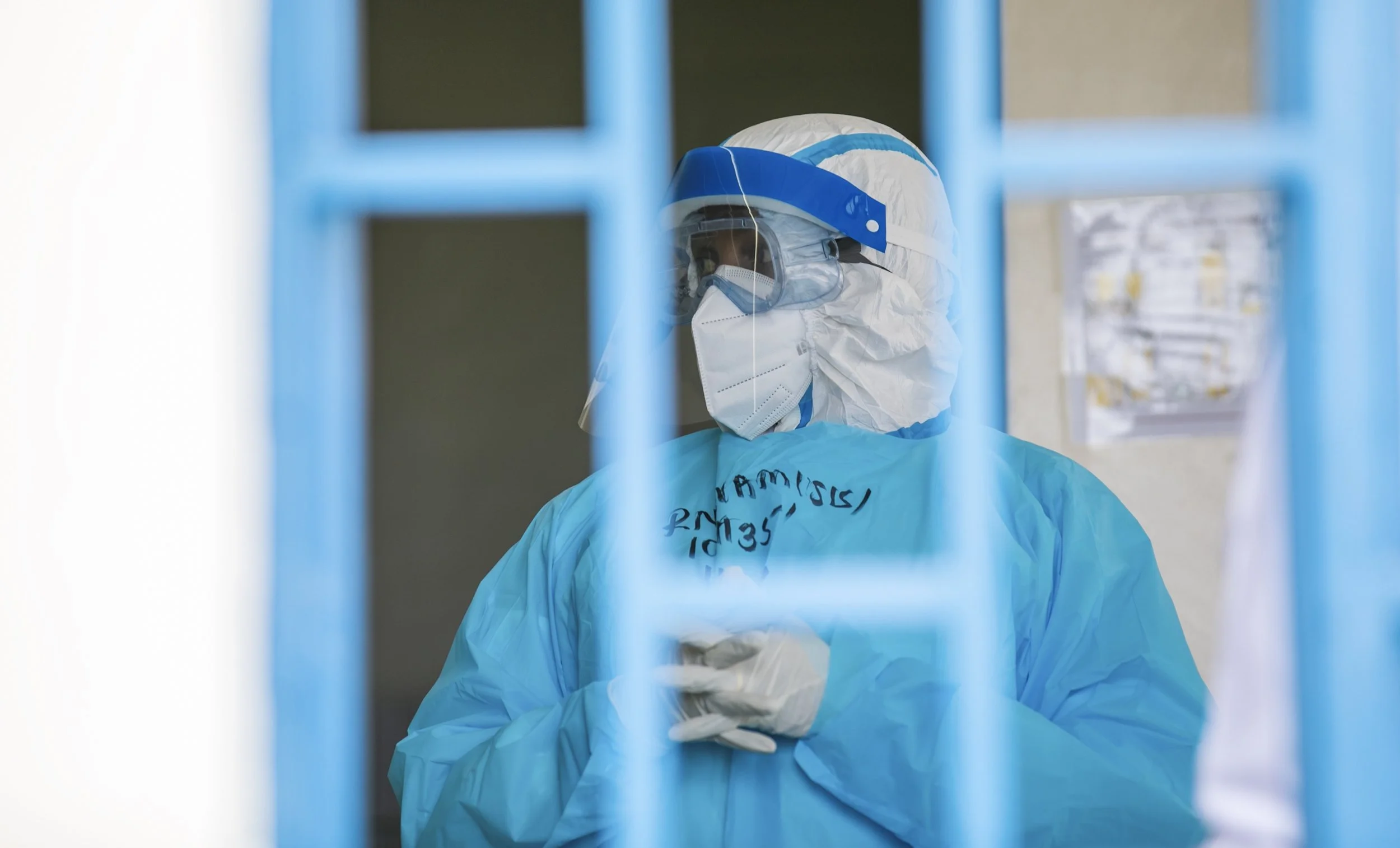
Photo: Ebola preparedness drill at King Faisal Hospital in Kigali, Rwanda. October 17, 2022.
By Peter Katona and Seth Freeman
Ebola is a frightening disease. It is a viral hemorrhagic fever, which damages the body’s circulatory system, causing high fever, organ failure, and internal bleeding. In an acute case, a patient’s skin can break, spraying blood and bodily fluid, a horrible, gory outcome that can infect others and spread the disease.
In 2014 a ferocious outbreak of Ebola in West Africa ended up infecting over 28,000 people and killing 11,310. The swift and vigorous response of the Obama administration was widely considered a major public health success. With a single person, Ron Klain, in charge of overseeing and coordinating its efforts, the U.S. deployed over 3,500 military and civilian personnel to West Africa while establishing 15 dedicated Ebola treatment Units, enhanced screening at airports, and other measures in the U.S. and abroad. Ultimately, only two people contracted Ebola in the United States, a pair of nurses who had treated an infected traveler. Both fully recovered.
The present administration’s approach to today’s Ebola threat is markedly different – and dangerously inept in almost every respect. It is hard to know exactly how long the current outbreak in the Democratic Republic of Congo and Uganda was spreading through the population before it was recognized, but some observers believe the disease was infecting people for at least a couple of months, perhaps longer. The presentation of the current strain of Ebola, Bundibugyo, is similar to that of the earlier Zaire strain, even a bit milder, but unfortunately the tests designed for Zaire don’t identify cases of the new strain. The use of these ineffective tests initially resulted in numerous false negatives and a false sense of security, and the outbreak was slow to be recognized. But, more importantly, the tragically tardy response to the current emergency was more importantly an inevitable result of the Trump administration’s decimation of USAID and its decision to pull out of the World Health Organization. If we had had trained personnel on the ground, the outbreak most certainly would have been detected sooner.
The deadly consequences of these diagnostic failures were then compounded by the administration’s policy of travel bans and its decision to set up poorly run tent camps in Kenya –– staffed with untrained personnel and reserved only for American patients. These measures have expanded the crisis by creating a strong disincentive for people headed to the U.S. to report their symptoms or possible exposures. The tent camp construction has been challenged in Kenyan courts, and there have been protests at the proposed sites. The policy is also flatly unethical. All U.S. citizens deserve the best possible medical care, care which exists – in the U.S. Ebola is a high mortality disease which requires significant medical resources. To deny Americans entry to their own country prevents those who might in fact have Ebola from getting the very best treatment. Thus, Secretary of State Marco Rubio’s inflated rhetoric, “We cannot and will not allow any cases of Ebola to enter the United States,” sounds protective but is just empty political theater that makes everyone less safe in practice.
So where are we headed? The world first became aware of Ebola in 1976. One of us (Dr. Katona) took part in testing healthcare workers and missionaries for hemorrhagic viruses on the ground in Africa in the late 1970s and early 1980s and knows Ebola well. It is a terrible, scary disease but Ebola’s particularly gruesome mechanism of spread makes it highly unlikely that it could infect as many people as Covid or the flu or measles. Additionally, unlike with Covid, transmission by asymptomatic individuals is not a factor. You have to get near enough to an infected person to be contaminated by their blood or other body fluids, so if you are not in close contact with Ebola patients, you will not get the disease. We do not need to panic. What we do need is to act deliberately and intelligently. We should institute a robust regime of testing all travelers from infected areas at all U.S. entry points. We should develop a vaccine against the Bundibugyo virus quickly and effectively. And we should treat anybody who has the disease promptly, expertly and with compassion in specialized facilities.
We have to stop the political clowning and the bumbling response. The United States is the most scientifically and medically advanced nation on the planet. It needs to start acting like it.
Peter Katona, MD, a Pacific Council on International Policy member, has been a clinical professor of medicine at the UCLA David Geffen School of Medicine in Infectious Diseases, and an adjunct professor of Public Health at the UCLA Fielding School of Public Health in Epidemiology. He helped design UCLA’s campus COVID policy.
Seth Freeman, MPH, a Pacific Council on International Policy member, is an Emmy-winning writer/producer for television, a playwright, and a journalist, who writes about technology, education, policy, and public health.
The views and opinions expressed here are those of the author(s) and do not necessarily reflect the official policy or position of the Pacific Council.
